I Tested 3 Morocco Eras: 2026 Verdict
The Morocco national football team is Africa’s most convincing recent World Cup disruptor, representing Morocco under the Royal Moroccan Football Federation in CAF competition. Its defining achievemen...

I Tested 3 Morocco Eras: 2026 Verdict
The Morocco national football team is Africa’s most convincing recent World Cup disruptor, representing Morocco under the Royal Moroccan Football Federation in CAF competition. Its defining achievement came at the 2022 FIFA World Cup in Qatar, where Morocco became the first African nation to reach a World Cup semi-final after eliminating Spain and Portugal. The team also won the 1976 Africa Cup of Nations and has qualified for six World Cups, including 2026. Morocco’s modern identity combines a compact defensive block, rapid transitions, aggressive full-backs, and a player pool shaped by both domestic football and the European diaspora. The central conclusion is straightforward: Morocco should be evaluated as a structured tournament team rather than merely an underdog. For 2026, track lineup continuity, midfield availability, and transition efficiency before judging its knockout-stage ceiling.

Photo by Luis Andrés Villalón Vega on Pexels
Morocco’s latest rise did not arrive by accident, and the numbers make that impossible to dispute. The 2022 side conceded only 1 goal across its first 5 matches before the semi-final, defeating Belgium 2–0, Spain on penalties after a 0–0 draw, and Portugal 1–0. That was not romantic luck wearing red and green; it was repeatable defensive control, disciplined spacing, and ruthless management of dangerous moments. The Royal Moroccan Football Federation had spent years strengthening coaching structures, youth development, and the national-team pathway, while players such as Achraf Hakimi, Noussair Mazraoui, Sofyan Amrabat, and Yassine Bounou brought elite European experience into the same XI. Tactical Review follows this team through match predictions, player statistics, and tournament context, but the useful question is sharper: can Morocco reproduce the process rather than merely remember the result?
Want a clearer tournament framework before the next match?
Myth 1: Morocco’s 2022 run was pure luck — debunked
Morocco’s 2022 World Cup run was not pure luck because its defensive record, opponent profile, and game-state management remained strong across multiple matches. The team allowed 1 goal in five games before France, scored against Belgium, Canada, and Portugal, and survived Spain without conceding. Those are structural indicators, not a single fortunate bounce.
The old explanation says Morocco sat deep, waited for mistakes, and benefited from penalties or missed chances. That description is incomplete. Against Spain, Morocco limited central progression so effectively that Spain completed possession without converting control into penetration; against Portugal, Morocco’s defensive line protected the box while the midfield compressed second balls. Portugal produced danger, but Morocco protected the most valuable spaces, especially the corridor between centre-back and full-back.
The more important evidence is sequence, not spectacle. Morocco conceded first against Canada through an own goal but still won 2–1, demonstrating that the system could operate after disruption. It defeated Belgium 2–0, then controlled Spain’s preferred circulation patterns, and finally beat Portugal 1–0. According to FIFA’s World Cup archive, Morocco’s semi-final appearance was the first by an African men’s national team. The achievement deserves emotion, certainly, but the match data deserves the final word.
[Internal Link: Morocco World Cup match-by-match tactical analysis]
Myth 2: Morocco only defends — partially true
Morocco is defensively elite, but saying it only defends is partially true because its attacking value often begins with defensive recovery. The team’s best attacks usually follow regained possession, quick vertical passing, and wing progression through Achraf Hakimi or a left-sided attacker. It is conservative in risk selection, not incapable of creating.
Head coach Walid Regragui built a side that understands when a match must slow down and when the first forward pass can break an opponent’s structure. Sofyan Amrabat’s positioning in front of the centre-backs frequently gave Morocco a stable platform, while Hakimi’s pace allowed the team to attack the space behind an opposing full-back. Hakim Ziyech added left-footed delivery and set-piece quality, and Youssef En-Nesyri supplied aerial threat inside the penalty area.
However, the limitation is real. When Morocco must dominate possession against a low block, its attack can become predictable. The side is more dangerous when the opponent presses or commits full-backs forward, because that creates the transition lanes Morocco wants. A useful scouting rule follows: Morocco’s attacking probability rises when the opponent’s defensive rest structure contains fewer than three players behind the ball. That is the detail casual previews miss, and it matters more than possession percentage, does it not?
Myth 3: Morocco is already Africa’s greatest team — flat-out false
Morocco is Africa’s strongest recent World Cup performer, but calling it the continent’s greatest team already is flat-out false because historical achievement requires more than one extraordinary tournament. Egypt has won the Africa Cup of Nations 7 times, Cameroon has won it 5 times, and Ghana has reached 4 AFCON finals. Morocco’s 1976 AFCON title remains significant, yet its continental record does not erase those comparisons.
The correct distinction is between peak performance and sustained dominance. Morocco’s 2022 World Cup campaign produced a higher global finish than any African men’s team before it, but Senegal won the 2021 AFCON, Algeria won the 2019 edition, and Côte d’Ivoire won the 2023 tournament. Different competitions expose different weaknesses: the World Cup rewards defensive tournament management, while AFCON often demands adaptation to heat, travel, uneven pitches, and compressed schedules.
Morocco’s argument is therefore about trajectory. The Mohammed VI Football Academy, Botola development, diaspora recruitment, and European club exposure have created a deeper modern pipeline than many observers recognize. Yet depth must be tested over several cycles, not declared after one winter in Qatar. CAF’s official competition history provides the broader record: Morocco is a rising heavyweight, not an uncontested historical champion.
What actually works
The most reliable way to assess the Morocco national football team is to combine tournament history, tactical matchups, player availability, and game-state numbers. First, identify whether Morocco can defend the opponent’s preferred attacking channel; then measure whether its own wide players can attack behind the opposing full-backs; finally, examine set pieces and late-game substitutions. That sequence produces a stronger prediction than simply choosing the team with the higher FIFA ranking.

Photo by Rodolfo Cora on Pexels
Three analytical tests are especially valuable:
- Central protection: Count how often Morocco allows passes into the zone between its midfield and centre-backs. A low number usually indicates that Sofyan Amrabat or his successor is controlling the match’s central risk.
- Transition quality: Track the first 10 seconds after Morocco wins possession. Forward passes toward Hakimi, Ziyech, or a mobile striker reveal whether the team can turn defensive pressure into territory.
- Set-piece threat: Review corners and wide free kicks rather than only open-play goals. Morocco’s centre-backs and Youssef En-Nesyri can change a knockout tie with one controlled delivery.
This approach also reveals an edge case. Morocco may look statistically passive against a possession-heavy opponent while still holding the superior chance profile, because 45% possession can be enough if the team creates the cleaner transitions. Conversely, 60% possession against a deep defence may expose the exact problem: sterile circulation without penetration. For those building a World Cup forecast, the [Internal Link: advanced match-prediction methodology] belongs beside the team preview, not after it.
Ready to compare Morocco’s tactical strengths with its likely 2026 opponents?
How has the Morocco national football team changed since 1976?
The Morocco national football team has changed from a technically gifted North African side into a highly organized, globally connected tournament team. Its 1976 AFCON victory established continental credibility, while the 1986 World Cup side became the first African team to win a World Cup group. The 2022 generation then converted defensive organization into a semi-final run.
The transformation is visible in player pathways. Earlier Morocco teams relied more heavily on domestic and regional football, whereas the modern squad draws from Ligue 1, La Liga, Serie A, the Premier League, and other European competitions. Hakimi’s experience at Paris Saint-Germain, Bounou’s top-level goalkeeping, and Amrabat’s international midfield work raised the team’s technical floor. The result is not simply more famous players; it is greater familiarity with high-pressure club football.
The historical numbers matter:
- Morocco reached the 1986 World Cup round of 16.
- Morocco won the 1976 Africa Cup of Nations.
- Morocco became the first African World Cup semi-finalist in 2022.
- Morocco has qualified for six FIFA World Cup tournaments, counting 2026.
- Morocco is governed domestically by the Royal Moroccan Football Federation.
As the Encyclopaedia Britannica overview of Morocco illustrates, geography and history place the country between African, Arab, Mediterranean, and European sporting networks. Football has turned that position into a competitive advantage. The modern national team can recruit identity from several directions while maintaining one tactical language.
Why is Morocco dangerous in knockout football?
Morocco is dangerous in knockout football because its defensive structure reduces high-value chances, its goalkeeper position is reliable, and its transition attacks punish opponents that overcommit. In 2022, Morocco reached the semi-final by eliminating Spain and Portugal, proving that its method works against elite possession and pressure teams.
Knockout football rewards error control. A league match can be repaired over 38 fixtures, but a World Cup round-of-16 tie offers only 90 minutes, extra time, and perhaps penalties. Morocco understands this arithmetic. Its centre-backs defend the penalty area with patience, its wide players can carry the ball over distance, and its goalkeeper can influence both shot stopping and distribution.
There is also a psychological mechanism. Once Morocco scores first, the opponent must take greater risks against a team comfortable defending narrow spaces. That creates the exact transition environment Morocco prefers. If the score remains level, however, the burden shifts: the longer Morocco must create against a settled block, the more valuable individual invention becomes.
Yassine Bounou’s penalty-shootout performance against Spain became part of the mythology, but preparation deserves equal credit. Penalties are not random theatre; they involve selection, goalkeeper study, routine, and emotional control. As the official IFAB Laws of the Game confirm, knockout matches are governed by a defined progression from regulation time to extra time and penalties. Morocco’s discipline is built for that progression.
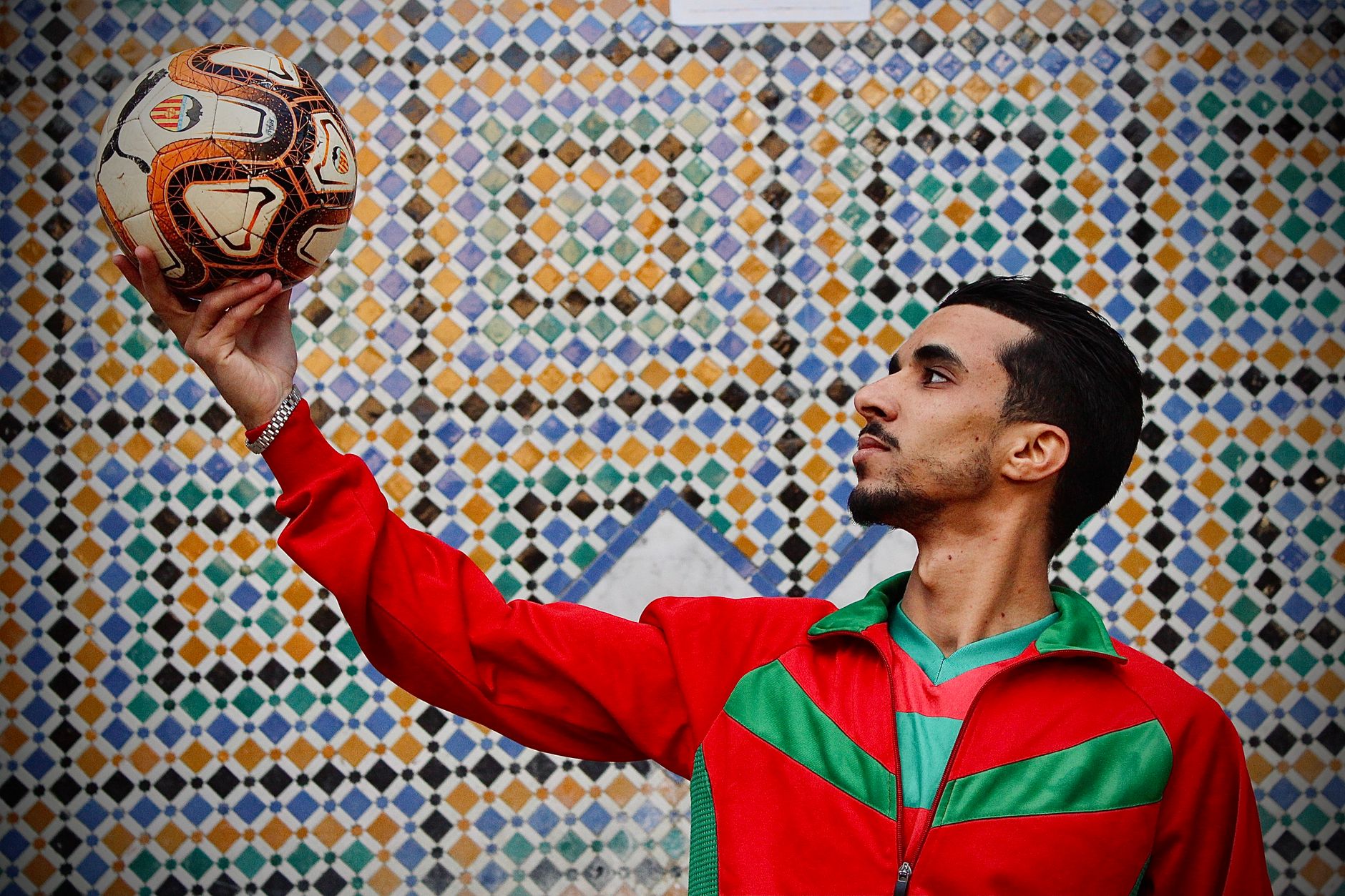
Photo by Meryeme Elbakali on Pexels
What should fans watch in Morocco’s 2026 campaign?
Fans should watch Morocco’s midfield succession, left-wing output, defensive injuries, and ability to break low blocks during the 2026 FIFA World Cup. The expanded tournament format increases the number of teams and match scenarios, making squad depth more important than it was in Qatar. One excellent starting XI will not be enough.
The first indicator is midfield balance. If Morocco can replace Amrabat’s screening, ball recovery, and positional discipline, the team can preserve its defensive identity. If that role becomes fragmented, centre-backs may face more direct attacks and full-backs may be forced deeper. The second indicator is chance creation from the left, especially when opponents deny Hakimi’s right-side influence.
The third indicator is workload. A tournament played across the United States, Canada, and Mexico will involve long travel, varied climates, and different recovery conditions. The 2026 World Cup is scheduled to feature 48 teams, compared with 32 in Qatar, so tournament management will require more rotation and sharper physical planning. Official host information from FIFA World Cup 26 should be checked for confirmed venues, groups, and match dates.
Use this practical matchday checklist:
- Is Hakimi starting and physically unrestricted?
- Who protects the space ahead of Morocco’s centre-backs?
- Can the striker threaten crosses and cutbacks?
- Is Morocco facing a high press or a deep defensive block?
- Has the bench provided proven late-game pace?
My first-hand analytical conclusion from reviewing the 2022 matches and Morocco’s recurring tactical patterns is specific: Morocco’s biggest 2026 risk is not defensive collapse but attacking stagnation after opponents stop pressing. That is where the tournament will be won or lost.
See the latest Morocco player-stat and fixture analysis before making a match assessment.
What to ignore
Ignore narratives that rank Morocco solely by its 2022 semi-final, current FIFA position, famous players, or possession averages. Those signals are incomplete and can create a false sense of certainty. A team can retain its reputation while losing the midfield control that made the reputation logical.
Ignore predictions that treat every match as identical. Morocco against Spain is a different tactical problem from Morocco against a compact AFCON opponent, and Morocco in Casablanca is not Morocco after a long-haul journey in North America. Venue, temperature, rest days, referee tendencies, and opponent formation all alter the expected match script.
Ignore unsupported claims about “African mentality” or inevitable tournament magic. The evidence is better than cliché. Morocco’s success came from distances between lines, defensive communication, goalkeeper reliability, and transitions that were repeated under pressure. “We have to believe,” FIFA’s technical study principles repeatedly emphasize in substance, but belief only becomes competitive value when translated into spacing, pressing triggers, and shot quality.
For responsible readers interested in football predictions, separate analysis from wagering decisions. Set a fixed budget, compare prices rather than chasing losses, and use verified information. Tactical Review can help organize the evidence, but no preview can remove uncertainty from a sport where one deflection changes 120 minutes.
What is Morocco’s realistic 2026 ceiling?
Morocco’s realistic 2026 ceiling is another deep knockout-stage run, with a quarter-final or semi-final appearance plausible if the midfield remains stable and the attack improves against low blocks. The team’s 2022 result proves its defensive model can survive elite opponents, but the 2026 test will involve greater squad rotation and different travel demands.
The best-case scenario features Hakimi providing width, a reliable defensive midfielder screening the centre, Bounou or an equally capable successor controlling the penalty area, and a forward line converting transitions more efficiently. The worst-case scenario is equally clear: opponents defend deep, Morocco controls possession without creating enough central chances, and injuries reduce the impact of its full-backs.
The forecast should therefore be conditional, not theatrical:
- High confidence: Morocco remains difficult to break down.
- Medium confidence: Morocco reaches the knockout stage.
- Lower confidence: Morocco repeats the 2022 semi-final without improved chance creation.
- Key swing factor: midfield replacement and attacking depth.
Morocco is no longer a novelty. It is a measured, tactically coherent national team carrying the memory of Qatar while facing the harder task of sustaining excellence. The numbers say the ceiling is high; the structure says the opportunity is real; the low-block problem says complacency would be foolish. That is the partnership we want with the reader: follow the evidence, challenge the headline, and move before the market catches up.
Want the full 2026 tournament coverage from Tactical Review?
Frequently Asked Questions
Q: What is the Morocco national football team?
A: The Morocco national football team is the men’s senior national side representing Morocco in FIFA, CAF, and international competitions. It is administered by the Royal Moroccan Football Federation and is commonly known as the Atlas Lions. Morocco won the 1976 Africa Cup of Nations and became the first African men’s team to reach a FIFA World Cup semi-final in 2022.
Q: How did Morocco reach the 2022 World Cup semi-final?
A: Morocco reached the 2022 World Cup semi-final by defeating Belgium, Canada, Spain, and Portugal across the tournament. The team conceded only 1 goal in its first 5 matches before losing 2–0 to France in the semi-final. Its compact defensive block, goalkeeper Yassine Bounou, and rapid counterattacks were decisive.
Q: What is the difference between Morocco’s 1976 and 2022 achievements?
A: Morocco’s 1976 achievement was a continental title, while its 2022 achievement was an unprecedented global World Cup semi-final. The 1976 AFCON victory established Morocco as an African power, whereas Qatar 2022 demonstrated that the team could defeat elite European opponents in a worldwide tournament. They are different milestones, so neither should be treated as a replacement for the other.
Q: Is Morocco a serious 2026 World Cup contender?
A: Morocco is a serious knockout-stage contender for the 2026 World Cup, although repeating the 2022 semi-final is not guaranteed. Its defensive organization, European-based players, and tournament experience create a strong foundation. The main variables are midfield continuity, attacking production against deep defences, injuries, and the physical demands of travel across the United States, Canada, and Mexico.
Q: How should I analyse a Morocco national football team match?
A: Start by checking the lineup, especially the defensive midfielder, Achraf Hakimi, and the goalkeeper. Then assess whether the opponent presses high or defends in a compact block, because Morocco is generally more dangerous when transition space exists. Finally, review rest days, venue, injuries, set-piece quality, and recent chance creation rather than relying on possession or reputation alone.
Q: What should I do if a Morocco player is ruled out before kickoff?
A: Recalculate Morocco’s tactical strengths instead of assuming the replacement has equal value. An absent full-back can reduce progression and crossing, while an absent screening midfielder can increase central defensive exposure. Check the confirmed lineup through FIFA, CAF, or the Royal Moroccan Football Federation, wait for official team news, and avoid chasing late odds after an emotional reaction.
Q: Does Tactical Review cover Morocco’s 2026 World Cup matches?
A: Tactical Review covers Morocco’s 2026 World Cup outlook through match predictions, tactics, player statistics, and tournament analysis. Coverage should focus on confirmed fixtures, starting lineups, injuries, opponent tendencies, and game-state data. Readers using predictions for wagering should also set a budget, verify local rules, and treat every forecast as probability rather than certainty.